 Andarta
Start with a detail someone remembers
Ask people who knew them what they remember about ordinary moments. What did they love to do? What would they say when they walked into a room? What mattered to them about this place? A brief story, a family expression, or a photograph someone keeps can provide the opening for a personal line.
Start your draft with the name of the person or group. Add a brief explanation if visitors need one, and leave room for a personal line. For a bench overlooking a view someone loved, one possible dedication is “She loved to pause here and watch the day begin.” At the entrance to a community space, a short line about what took place there can explain why the dedication is in that location.
Decide what visitors should read first
A plaque can have three levels of information. Begin with a name or dedication heading, follow with a personal line or context about the place, then include details such as dates or additional languages. For a public plaque with many names, agree on the order beforehand and make sure every name is legible. On an institutional or workplace plaque, give the names and the purpose of the memorial a clear place, even when the sponsoring organization is credited.
A link or QR code can lead to a longer account, photos, or a recording you have permission to share. Keep enough information on the plaque itself for any visitor to understand who it commemorates. If you add a code, test it from where visitors will stand and agree on who will maintain the linked content.
Test the lettering on site
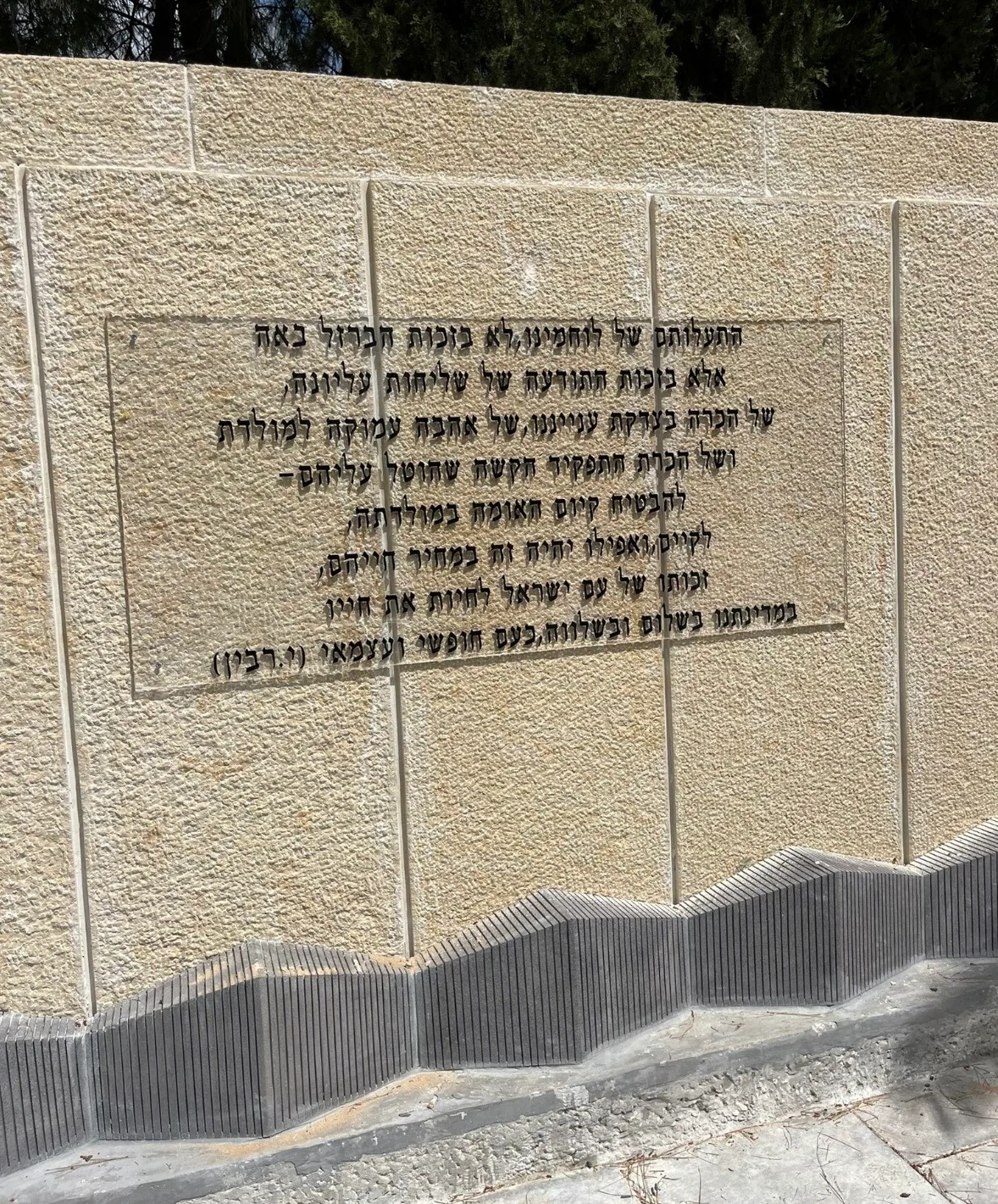
Ask for a full-size printout that shows the typeface, line breaks, and spacing. Read it from where visitors will stand and, if possible, at seated eye level as well. If light reflects off the surface, the stone pattern competes with the words, or the lines feel crowded, adjust the spacing, contrast, or finish and test again. Guidelines for legible signage, Smithsonian.
Approve a single final proof
Review the file together in the layout that will appear on the plaque. Ask one person to read it aloud while another checks it against a source agreed upon by the family or organization. If there are several names, each person can review the relevant section before a designated reviewer gives final approval.
- The full spelling of each name, including nicknames or transliterations where relevant.
- Dates and the order in which they appear, including Hebrew calendar dates if you are using them.
- Reading order for Hebrew, numerals, and Latin script, especially on mixed-script lines.
- Spacing, line breaks, and punctuation exactly as they will be engraved.
From a general tribute to a detail you can picture
Imagine writing a memorial plaque for a neighbourhood garden. This is a fictional example. The first draft reads, “In memory of Yael, who loved the neighbourhood and helped everyone.” In conversation, the family recalls one detail clearly. On Fridays she left seedlings by the garden gate and invited neighbours to take them. That memory might become two simple lines on the plaque. “In memory of Yael. On Fridays, she left seedlings by the gate for neighbours to take.”
Try the same exercise with your draft. Mark a broad line such as “He always looked out for others” and ask where people saw that care in daily life. Listen to their stories and choose one detail the family is comfortable sharing. Read the line aloud and imagine someone seeing the plaque for the first time. If the place or action is still unclear, add a word that helps the reader picture it.
Before approving an inscription, look at it on the stone or metal you have chosen. The materials guide shows how to compare two samples of memorial lettering using the same letter size and spacing.